
Grief Counselor in Menlo Park
For professionals who have it together on the outside and are exhausted on the inside
Everyone Keeps Asking How You're Doing and You've Stopped Telling the Truth
You say you're fine. You go to work, you answer the texts, and people tell you how strong you are. You nod because it's easier than explaining that you don't feel strong. The loss isn't new anymore, at least not to anyone else. The calls and the check-ins have slowed down, and you're expected to have moved on with everyone else.
But you haven't. You still reach for your phone to call someone who won't pick up. You still have moments where you forget, just for a second, and then it hits you all over again. Some days you're functional and some days you're going through the motions with nothing behind it. The worst part might be that no one around you sees the difference.
You've tried to work through it on your own. You've talked to friends, maybe tried therapy before. But the grief didn't move. It just sat there, underneath everything, and you worked around it because that's what you know how to do.
How We'll Work on This Together
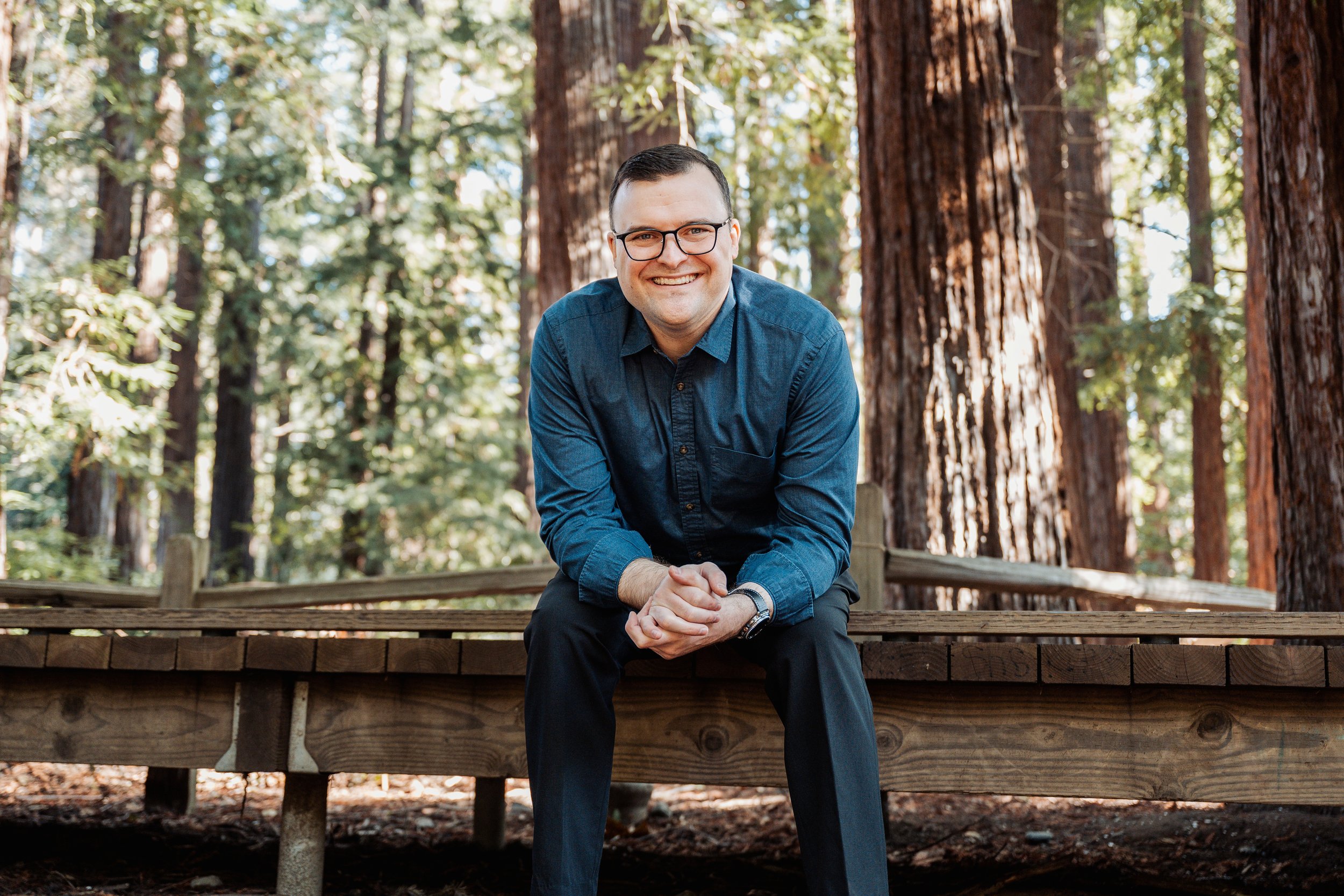
Ryan Thurwachter, Menlo Park Therapist Specializing in Grief
I'm Ryan Thurwachter, LCSW, a therapist in Menlo Park who specializes in grief. My primary approach is Internal Family Systems therapy, or IFS. IFS works with the idea that your mind isn't one unified voice, it's made up of different parts, each carrying a different piece of what you're going through. The part of you that keeps showing up to work like nothing happened. The part that still can't drive past the restaurant you used to go to together. The part that breaks down when it feels like the loss is too much to carry. You can read more about how IFS works on my IFS Therapy page.
If previous therapy felt like you were talking about the loss without anything underneath actually shifting, there's a reason for that. Most approaches treat grief as a story to tell. IFS treats grief as something your whole system organized around. It works with the parts that went numb or are still carrying guilt, rather than asking you to push through faster than you're ready for. I'm a Level 2 IFS therapist through the IFS Institute, trained to work with the more complicated inner systems that grief tends to become when it’s stayed stuck for years. Grief that doesn't ease after an extended period is now recognized clinically as prolonged grief disorder, added to the DSM-5-TR in 2022.
Almost everyone I see for grief arrives carrying some version of the same shame: that they should have been able to handle this on their own by now. For some people that shows up as performing, holding it together at work and letting no one see it. For others, the people around them know exactly how much they're struggling, and the shame is in feeling like they've become too much. By the time someone reaches out, it's usually because something forced the issue, a fight with someone who matters, a panic attack that landed them in an emergency room, or a long stretch of not being able to make an important life decision and not understanding why.
Grief is personal territory for me. I lost my baby brother when I was eleven, and two more siblings since then to overdoses. I've done my own work on it, which is part of why I don't ask anyone to move through this faster than they're ready to. You can read more about that on my About Me page.
What Changes
One client told me she spent years trying to logic her way through grief of losing her mother, staying busy so she didn't have to feel it. Through our work she was able to sit with what she was feeling without being consumed by it. She could let herself grieve without falling apart, something she hadn't been able to do before we started. Another described realizing he had been carrying guilt for years that wasn't his to carry, and slowly letting that weight shift. What clients tell me most often is that the grief doesn't disappear, but it stops running everything. They can carry it without it taking over their life.
If you've been carrying this longer than you thought you would, I'd like to talk. Book a free consultation and we'll figure out together whether this work makes sense for where you are now. It's a real conversation, not an intake form, and most people know by the end of the call.
Currently accepting new individual clients.
In-person in Menlo Park and online across California and New Jersey.
You can also reach out by calling 669-577-6800 or by email here.
Your inquiry is confidential. I typically respond within one business day.
Frequently Asked Questions
These are some of the most common questions about grief, answered from what I see in my practice.
-
A grief counselor works with people who are carrying a loss that hasn't found a way to move. That might be the death of someone close, the end of a significant relationship, a pregnancy loss, a career that defined you, or a shift in identity you didn't choose and didn't expect. The work isn't about getting over the loss or moving through it on a timeline. It's about creating enough space for the grief to be present, understood, and felt in a way that daily life rarely allows. A grief counselor helps you understand what the loss means to you specifically, not what it should mean, and works with the parts of the experience that have been pushed aside because they were too complicated, too painful, or too hard to explain to the people around you. The goal is not resolution in the sense of the grief going away. It's integration, finding a way to carry what you're carrying without it carrying you.
-
It depends on the nature of the loss and how it's presenting. Grief that is recent and acute often benefits first from support and space, a place to feel it, without having to manage how the grieving affects the people around you. Grief that has been present for a long time without moving, or that is entangled with earlier losses, relational wounds, or a sense of identity disruption, tends to need more than support. Approaches that work with the underlying meaning the loss carries, and with whatever has kept it from moving, tend to get further with complicated or prolonged grief. IFS is well suited here because grief is rarely just one thing. There's often a part that can't stop grieving alongside a part that can't start, a part that's angry alongside a part that feels guilty for being angry. Working with those layers directly tends to reach more of what's underneath than treating grief as a single feeling to be moved through.
-
The five stages, denial, anger, bargaining, depression, and acceptance, come from Elisabeth Kübler-Ross's 1969 work with people facing terminal illness, not originally with bereaved people. They've since been applied broadly to loss of all kinds. The model is widely known and many people find it useful as a rough map. The important caveat is that the stages were never meant to be a linear sequence, and Kübler-Ross herself said so. People don't move through them in order, don't experience all of them, and frequently cycle back. Grief doesn't follow a schedule. The model is less useful as a checklist of what you're supposed to feel and more useful as a way of normalizing that grief includes more than sadness, that anger, bargaining, and a kind of numbness are all legitimate parts of a response to loss, not detours from it.
-
If grief is affecting your functioning, your relationships, or your sense of yourself in ways that haven't shifted over time, then yes. Many people move through loss with the support of people around them and don't need professional help to do it. But grief becomes worth addressing clinically when it has been present for a significant period without changing, when it's interfering with daily life in sustained ways, when it's entangled with complicated feelings like guilt, relief, or anger that are hard to process without a container for them, or when the loss has triggered older material. A useful marker: if you're still organizing your life around avoiding the grief, or if the grief is still ambushing you in ways that feel destabilizing rather than just painful, a counselor can help. Loss that doesn't move on its own usually has something holding it in place, and figuring out what that is tends to require more than time.
-
The main thing that tends to complicate grief is not giving it room. Staying busy, staying productive, keeping it together for everyone around you, these are understandable responses to loss, particularly for people who are used to functioning at a high level. But grief that gets no space tends to surface elsewhere: in physical symptoms, in irritability, in a flatness that spreads beyond the loss itself, or in a delayed crash that arrives months later when the adrenaline of managing everything wears off. Equally unhelpful is the other extreme: getting so consumed by the grief that there's no movement at all. A few things worth naming specifically: alcohol and other numbing behaviors get in the way of what needs to move, without resolving anything. Grief comparisons, either dismissing your own loss because someone else has it worse, or measuring your grief against what others expect, aren't useful. And forcing a timeline, deciding you should be further along than you are, adds a layer of suffering onto an experience that's already hard enough.
-
"Releasing grief" isn't a clinical concept with a defined process, and any answer that presents a technique for it is overstating what the evidence supports. Grief does have a physical dimension, and that's well established. The tightness in the chest, the weight that settles somewhere behind the sternum, the exhaustion that isn't explained by sleep, are real experiences with a physical basis. In my experience the part holding that tension is doing a containment job, keeping grief at a manageable distance so you can function. Working with it directly, rather than trying to release or override it, is what I see move things. Permission tends to help more than technique. Permission to feel what's present without managing it, permission for the body to respond the way it responds, which sometimes means crying that arrives without a specific trigger, or physical tension that moves when it finally has space to. Movement, rest, and time spent outside are all useful supports, not because they release grief but because they support the nervous system during a period when it's under real strain. If physical symptoms of grief are severe or prolonged, that's worth bringing into the therapeutic work directly, since research on prolonged grief finds consistent associations with physical health problems.
-
A few questions that tend to surface useful information: How do you work with grief specifically, and what does that look like in a session? What's your experience with losses like mine? Do you have a particular model or approach you use, and why? How will we know if the work is helping? The last question is worth asking because grief work can be slow and nonlinear, and a therapist who has thought about how to track progress will be more useful than one who doesn't have an answer. It's also worth asking how they handle it when grief is entangled with more complicated feelings, relief, anger at the person who died, guilt about things left unsaid, since those are common and a therapist who treats grief as purely about sadness will be less equipped to work with the full range. Fit matters in grief work. You're going to bring some of the hardest material of your life into the room, and the relationship has to be able to hold it.
-
Complicated grief, sometimes called prolonged grief disorder, is more likely when the loss was sudden or traumatic, when it came without warning and there was no preparation or goodbye. Losses that carry ambivalence, the death of a parent with whom you had a difficult relationship, a miscarriage, the end of a relationship that was also harmful, tend to complicate the grief because it's entangled with other feelings that don't have the same cultural permission. Grief following a suicide loss is consistently associated with more complicated bereavement. So is grief involving estrangement, where the loss of the relationship preceded the loss of the person, leaving no clean endpoint. Prior losses that were never fully grieved can be activated by a new loss, making the current grief heavier than the present circumstance seems to warrant. A history of trauma, depression, or attachment difficulties also increases the likelihood that grief will become prolonged.
-
Most of the time, the terms are used interchangeably, and for most people searching for help with grief, that's fine. When people search for a grief counselor, they're usually looking for a licensed clinician who specializes in loss, which is what a grief therapist is. The technical distinction is that "grief counselor" can describe anyone providing grief support, including coaches and peer facilitators without a clinical license, while a therapist is a licensed mental health professional trained to treat what grief can become when it's stuck.
I'm a licensed clinical social worker, an LCSW, with grief-specific training through the Columbia Center for Prolonged Grief, in addition to my clinical training in Internal Family Systems. That license means years of supervised clinical training and ongoing accountability to a state board, not just a certificate in grief support.
If the grief is recent and uncomplicated, peer support and grief groups can be useful. For grief that has been present a long time, that hasn't moved, that is entangled with trauma or complicated relationships, or that has led to a loss of identity, working with a licensed therapist who has specific grief training tends to be the more appropriate level of care.
-
It tends to feel less like sadness than like a background condition: a flatness that's hard to explain, a reluctance to engage with things that used to matter, anniversaries and certain places or objects that carry a weight that doesn't diminish. There's often a sense that there's something you're working around, organizing your days to avoid, without always being conscious of what it is. Unprocessed grief shows up in physical symptoms that don't have a clear cause: fatigue, chest tightness, headaches, a body that seems to be holding something the mind has agreed not to look at. It can surface as irritability or difficulty connecting with people in ways that don't feel directly linked to the loss. And it has a way of being activated by new losses, minor ones that produce a response that feels too large for the occasion, because the new loss is carrying the weight of the older one underneath it.
In-Person and Virtual Therapy
In-person sessions in Menlo Park, minutes from Palo Alto. Virtual sessions throughout California and New Jersey.
Menlo Park Office
120B Santa Margarita Ave Suite 211
Menlo Park, CA 94025, United States
Ryan Thurwachter, LCSW | MSW, San Jose State University | BA, UC Santa Cruz | CA License #100577 | NJ License #44SC06030200
This page is written by Ryan Thurwachter, LCSW, based on five years of clinical practice. It is not a substitute for diagnosis or treatment. If you are in crisis, please contact 988.
Also find Ryan at Psychology Today, IFS Institute, Zencare, and TherapyDen.
Updated — August 2026
