
IFS Therapy in Menlo Park
For professionals who have it together on the outside and are exhausted on the inside
You Can See the Pattern But You Can't Stop
Part of you wants to open up, and another part won't let you. You can know you're overreacting and still not be able to stop. You can be completely logical about a situation and still feel overtaken by something that doesn't respond to logic. It's like there are different versions of you pulling in different directions, and you're caught in the middle while nothing changes.
Maybe it shows up as the inner critic that won't let you rest, even when you've done everything right. Maybe it's the part that shuts down in the middle of an important conversation, even though you promised yourself this time would be different. Or the part that keeps you up at night replaying something that happened ten years ago. The usual advice, to just think differently, try harder, or let it go, hasn't worked because it was never designed to reach the part of you that's driving all of this.
Who IFS Therapy Tends to Help
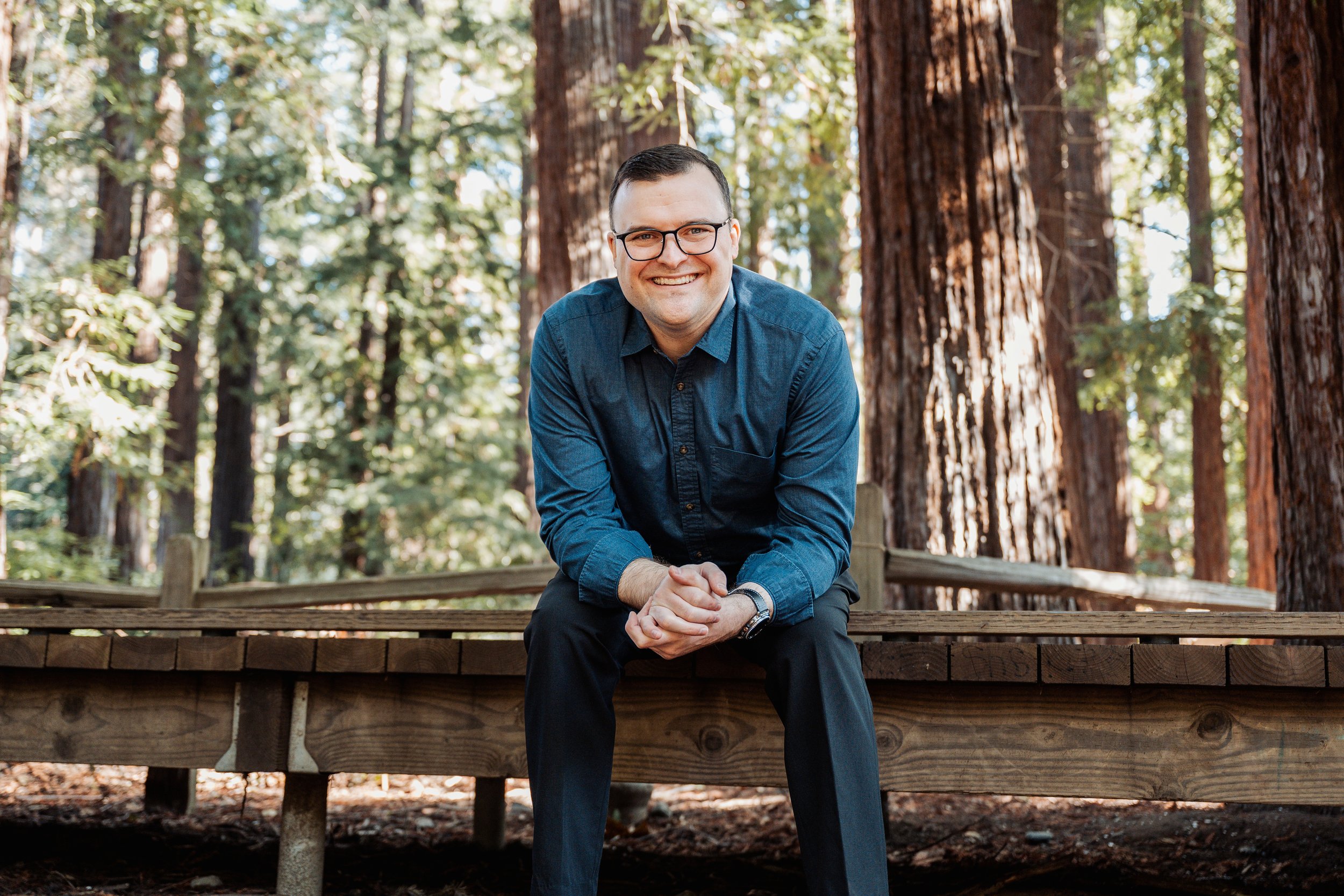
Ryan Thurwachter, Menlo Park Therapist Specializing in Internal Family Systems
I'm Ryan Thurwachter, LCSW, a Level 2 IFS-trained therapist who works with high-achieving professionals. I provide IFS therapy in Menlo Park and virtually across California and New Jersey. Most of the people I see can describe their patterns clearly. They've often done previous therapy, read the relevant books, and built real self-awareness. Most work in tech, finance, or law, and they're high-functioning in the areas that reward output. What they haven't been able to do is change what's underneath that.
The Parts of You That Are Working Hard to Cope
IFS sees the mind as made up of different parts, each with its own perspective and its own job. Managers keep your daily life under control. Firefighters react when the pressure breaks through: the impulse to numb out, snap at someone, or shut down completely. And exiles carry the original pain, the young feelings that the whole system is organized to keep you from having to feel. When these parts relax, you get access to a grounded, steady version of yourself that can lead.
What an IFS Therapy Session Looks Like
The first couple of sessions are for getting oriented. I want to understand what's going on for you and what you've already tried before you got here, and after that, each session connects to what came up the week before. Some sessions stay conversational. We'll talk about a part and what it's protecting. Other times the work goes more experiential, where I guide you in speaking directly to that part instead of talking about it. Which one happens depends on what's alive that day, not a fixed structure.
Most people start out talking about the problem, going over how frustrating or unfair it is, or analyzing which part is doing what. I'll ask a client to notice a specific part instead, the inner critic that says the same harsh things every time, or the part that gets overwhelmed in a hard conversation, and ask how it feels in their body. Underneath that noticing there's almost always another part working hard to keep the pain at a distance, afraid that feeling it directly would be too much. My job is to help the client reach the pain while staying grounded, so that protective part can stop working so hard.
A client who'd recently gone through a breakup got there this way: focusing on the part of him that believed he was unworthy, feeling the heartbreak as a physical ache, and putting a hand on his chest to let that part know it had been heard. When a client connects with a part like that, the part is getting an hour of real attention from the client and from me. That's hard evidence against its belief that he's unworthy. It usually doesn't want to hold that belief anymore once it's been experienced and understood the way it needed to be. The part becomes free to stop believing he's unworthy.
What Clients Tell Me
One client came in because he would freeze up in emotional conversations with his wife. It was predictable, it happened every time, and it was straining everything. Through our work with his parts, that pattern shifted. It still happens on rare occasion, but he goes into conversations now knowing it's not going to take over. Another client told me she spent years trying to manage her emotions through logic and willpower. IFS gave her something different: she could feel what she was feeling without being consumed by it, and for the first time she could choose how to respond instead of just reacting. Others tell me they finally understand why they are the way they are, and that understanding has made them more comfortable with themselves than they've ever been.
IFS for Burnout, Anxiety, Grief, and Trauma
IFS addresses anxiety by working with the hypervigilance directly rather than trying to argue it down. For burnout, it reaches the parts that have been driving performance without rest. For trauma, it works with the protective system rather than pushing past it. For grief, it makes room for what the loss is carrying.
If this framework makes sense of what you've been experiencing, that's worth paying attention to. Book a free consultation and we'll talk about what IFS could look like for you.
You can also reach out by calling 669-577-6800 or by email here.
Your inquiry is confidential. I typically respond within one business day.
Frequently Asked Questions
These are some of the most common questions about IFS therapy, answered from what I see in my practice.
-
IFS stands for Internal Family Systems, a model of therapy developed by Richard Schwartz in the 1980s. The core premise is that the mind is made up of distinct parts, each with its own perspective, feelings, and role in the internal system. Some parts protect you by managing your behavior and keeping difficult feelings at bay. Others carry the pain, shame, or fear from earlier experiences that the system hasn't been able to fully resolve. Underneath all of these parts, IFS posits a core Self that is not damaged by experience and is capable of leading the internal system with clarity and compassion. The work of IFS therapy is to help parts trust that Self enough to relax their protective roles, and to unburden the parts carrying old pain. Unlike approaches that treat symptoms as problems to eliminate, IFS treats every part as having a legitimate function, even the ones that cause the most difficulty.
-
Sessions are 50 minutes, including the first one. There's no separate intake hour, so we start working in the first session while I'm getting oriented to what brought you in and what you've already tried.
The work stays anchored to that pattern, whether it's anxiety that performs as competence, burnout that hasn't responded to anything else, or a relational dynamic that keeps producing the same outcome with different people. Whatever comes up in a given week usually connects back to it, in a way that becomes clearer over time.
The only homework I assign is practicing connection with the parts we've been working with, either through mindfulness and meditation or just noticing when one of them shows up during the week.
Most of the people I work with are used to solving problems by analyzing them, and that instinct shows up in session. Taking apart which part is doing what, mapping the system, treating the whole thing as something to optimize. Analyzing is a way of standing at a distance from the pain underneath, and the work tends to move slowly at first for exactly that reason. Sessions don't require you to close your eyes, follow a script, or revisit your history in detail. The pace is set by what you're ready to look at.
-
IFS is used across a wide range of presentations. It's particularly well established in the treatment of trauma, including complex and developmental trauma, where its approach of working with protective parts rather than pushing past them makes it well suited to people whose defenses are strong. Anxiety, depression, and burnout respond well to IFS because the model works with the underlying system generating symptoms rather than managing symptoms directly. Relational difficulties, including the patterns that repeat across different relationships despite genuine effort to change them, are often rooted in early experience that IFS addresses directly. It's also used for grief, identity disruption, perfectionism, and the particular kind of exhaustion that comes from high-achieving people who have been running on a logic of worth-through-output for long enough that they've lost touch with what they want. IFS is not a niche modality. It's a comprehensive framework that applies across most of the presentations a therapist sees regularly.
-
The "6 steps" framing circulates widely online but doesn't come directly from the IFS Institute's training materials or from Richard Schwartz's core texts. It's a simplification that various practitioners have developed to make the process more accessible. What IFS training does teach is a set of qualities and movements involved in working with parts: finding a part, focusing on it, fleshing it out, feeling toward it, befriending it, and then, when the time is right, approaching what it's protecting. Some practitioners teach this as a sequence, others as a set of orientations rather than fixed steps. The underlying process is less linear than any numbered list suggests, and the pace is set by what the parts are ready for rather than by a protocol. If you've come across a specific version of the steps and want to know whether it reflects the actual model, your therapist is the right person to ask.
-
They work differently and are better suited to different situations, so the more useful question is which is likely to be more helpful for a specific person with a specific presentation. CBT is structured and skills-focused. It's well researched for anxiety disorders, OCD, and depression, particularly when the goal is learning to recognize and change patterns of thinking and behavior. It tends to produce faster symptom relief in acute presentations. IFS works at a different level. Rather than teaching skills to manage symptoms, it works with the parts generating the symptoms and with the underlying experiences those parts are organized around. It tends to be slower and more exploratory, and it tends to produce more durable change for people whose patterns have been present for a long time, who have tried CBT without lasting effect, or whose difficulties are rooted in early relational experience rather than in specific thought patterns. For a lot of the people I work with, CBT helped for a while and then reached a ceiling. IFS is often what's useful after that ceiling.
-
They share some common ground and are sometimes used together, but they work differently. Both take the position that trauma is stored in a way that isn't resolved by insight or talking alone, and that something more direct is needed to shift it. EMDR uses bilateral stimulation, typically eye movements, to work through specific traumatic memories and reduce their emotional charge. The focus is on the memory itself. IFS works with the parts that formed in response to the traumatic experience, including the protectors that keep the memory at a distance, and approaches the underlying pain only when those parts are ready to allow it. EMDR tends to be more targeted and protocol-driven. IFS tends to be more relational and exploratory. Some therapists are trained in both and combine them, using IFS to build internal safety and then EMDR to work through specific memories when the system is ready. For complex or developmental trauma where the protective structures are strong, IFS often needs to come first.
-
Yes. IFS is recognized as an evidence-based practice by SAMHSA, the Substance Abuse and Mental Health Services Administration, through its National Registry of Evidence-based Programs and Practices. That designation is what clinicians and institutions typically mean when they ask whether a treatment is evidence-based, and IFS meets that standard. The broader research literature is still growing. Published studies cover chronic pain, depression, trauma, and self-criticism, and the IFS Institute maintains a current list of research on its website. The evidence base is less extensive than CBT or EMDR, which have decades of randomized controlled trials behind them, but the SAMHSA recognition reflects a meaningful threshold that IFS has cleared. For most people asking this question, the short answer is yes, it is evidence-based, and if you want to review the research directly, the IFS Institute maintains a current list at ifs-institute.com/resources/research.
-
A few worth naming. IFS is slower than symptom-focused approaches. If the goal is rapid relief from a specific, bounded anxiety or a discrete phobia, a structured CBT or exposure-based approach will likely get there faster. IFS requires a degree of introspective capacity and willingness to turn attention inward, and some people find that orientation uncomfortable or unnatural, at least initially. The quality of IFS therapy varies significantly depending on the therapist's training and experience. The model has gained enough mainstream attention that some therapists describe their work as IFS-informed after minimal exposure to it, which is different from a therapist with formal training through the IFS Institute. A session with an undertrained IFS therapist can feel unfocused or confusing. Finally, IFS isn't the right fit for everyone, and a good therapist will tell you that rather than trying to make the model work regardless of fit.
-
To a degree. Richard Schwartz has written a book specifically for this, No Bad Parts, which introduces the model and includes exercises for working with parts independently. Many people find it useful for building familiarity with the concepts and starting to notice their own parts outside of sessions. The limitation is that the most significant work in IFS, approaching the parts carrying old pain and helping them unburden, typically requires a trained therapist to facilitate. The protective parts that keep that material at a distance are often more willing to ease up when there's another person present who can help regulate the experience and who knows how to work with what comes up. Self-directed IFS practice can be a valuable supplement to therapy, and can help sessions go deeper because you're arriving with more familiarity with your own internal landscape. It's less useful as a substitute for the therapy itself, particularly for trauma or anything with a long history.
-
The IFS Institute maintains a therapist directory at ifs-institute.com, which lists practitioners by location and allows you to filter by training level. Level 1, 2, and 3 trained therapists have completed formal training programs through the Institute; the level indicates depth of training. When evaluating a therapist, it's worth asking directly about their IFS training, specifically whether they've completed formal training through the IFS Institute or another structured program, since the term is sometimes used loosely. A consultation call is the most reliable way to get a sense of whether the therapist's approach and your needs are likely to be a good fit. If you're in California or New Jersey and want to talk through whether IFS makes sense for what you're dealing with, I offer a free 15-minute consultation and you can book directly from this page.
In-Person and Virtual Therapy
In-person sessions in Menlo Park, minutes from Palo Alto. Virtual sessions throughout California and New Jersey.
Menlo Park Office
120B Santa Margarita Ave Suite 211
Menlo Park, CA 94025, United States
Ryan Thurwachter, LCSW | MSW, San Jose State University | BA, UC Santa Cruz | CA License #100577 | NJ License #44SC06030200
This page is written by Ryan Thurwachter, LCSW, based on five years of clinical practice. It is not a substitute for diagnosis or treatment. If you are in crisis, please contact 988.
Also find Ryan at Psychology Today, IFS Institute, Zencare, and TherapyDen.
Content reviewed by Ryan Thurwachter, LCSW — July 2026
