
Therapist for Burnout in Menlo Park
For professionals who have it together on the outside and are exhausted on the inside
You're Running on Empty
You woke up today already tired, not just physically, but deeply tired. The kind of exhaustion that doesn't go away with sleep. You hadn't even gotten out of bed yet, and you were already dreading the day. Somewhere in the last year or two, the engine that used to run all of this without thinking started requiring every ounce of willpower you have just to get through a normal day.
The things that used to interest you feel flat. You're going through the motions at work, performing well enough that nobody has noticed, but you can feel the difference. There's a numbness that's settled in where motivation used to be, and it's leaking into the rest of your life too, into your relationships, into the hour you spend each night on your phone without absorbing a single thing because doing something real feels like too much. Every once in a while it spikes into something worse, a wave where even getting out of bed feels like a chore, and then it passes and you're back to the low hum of not really caring about much of anything.
You have the career, the income, the life that's supposed to come with some version of satisfaction. And yet you feel less like yourself than you have in years. You've tried sleeping more, exercising, pulling back on your hours. None of it has touched whatever is actually going on underneath. You're starting to wonder if this is just what life feels like now.
The reason none of it has worked is that burnout, in the people I see, is rarely about doing too much. It's about parts of you that have been driving your performance for years without rest, without recognition, and without anyone asking them what they actually need. The achiever in you that learned early on that your value comes from output. The part that scans every room for what's expected of you and delivers it before anyone has to ask. These parts built your career, but they haven't taken a day off in decades, and no amount of productivity advice is going to give them what they're actually missing.
How We'll Work on This Together
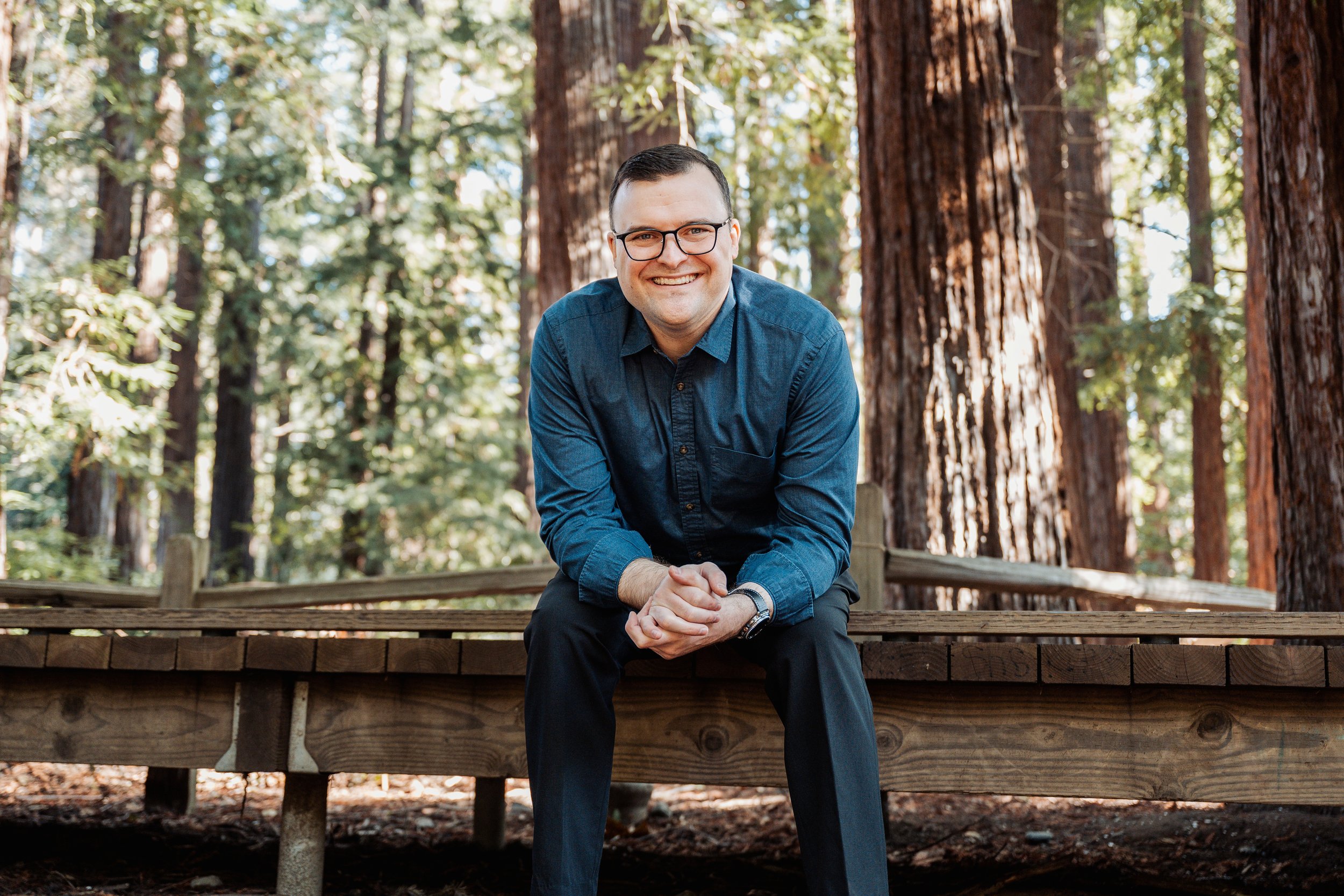
Ryan Thurwachter, Menlo Park Therapist Specializing in Burnout
I'm Ryan Thurwachter, LCSW, a therapist in Menlo Park, near the Palo Alto border, who works with professionals whose job burnout runs deeper than workload. The people I see work in tech, finance, law, medicine, and other demanding fields where the expectation is that you perform at a high level indefinitely and never let anyone see the cost. Most approaches treat burnout as an output problem, and the advice all sounds the same: do less, set better limits, and practice self-care. For most of the people I work with, that advice hasn't helped because it doesn't reach the part of them that genuinely cannot stop. That part is protecting something, usually a much younger part that learned long ago that being useful was the only reliable way to be valued, and that resting meant becoming invisible. Until that part is heard, you burn out, recover slightly, and burn out again.
I use Internal Family Systems therapy because it works with the parts running the burnout rather than trying to override them. The driven part of you that can't seem to stop, the achiever that's been performing for decades, the numbing part that's behind the flatness and the phone-scrolling and the inability to care about what you used to care about, all of it is still running because those parts believe they're protecting you. The driver learned somewhere early on that being useful was how you stayed valued, and resting felt like a risk it couldn't afford to take. The numbing part stepped in when the driving became unsustainable, dimming everything down to keep you functional when you couldn't slow down any other way. When we work with these parts directly, when we understand what they're actually afraid will happen if they let up, the grip loosens. The driver doesn't have to carry everything alone, and the numbness lifts because it's no longer the only thing keeping you from collapse. You can learn more about how IFS works here.
What Actually Changes
One client described his life before therapy as "all about distractions and looking outside of myself: overeating, drinking, going to the gym a lot, taking on a lot of projects." What changed was that he could finally sit with himself without needing to fill every minute. He told me he went from always reaching for the next "brass ring," the next box to tick, to actually feeling present in his own life, and that he started using what we'd built in sessions to feel better daily, on his own, without needing the next distraction to get him through.
Another client came in during one of the lowest stretches of her life, physically depleted, emotionally raw, and overwhelmed by how much she'd been carrying. Over time, she told me she felt much more collected and stable on a regular basis, with far less of the really big emotions that used to define her weeks. She stopped overextending herself for everyone around her and started recognizing when she was reaching a breaking point before she hit it. She told me she felt more like herself than she had in years. And something she hadn't even mentioned to me, debilitating daily headaches she'd had for as long as she could remember, stopped completely.
If you've been running on empty and everything you've tried has stayed at the surface, book a free 15-minute consultation. It's a real conversation about what's going on and whether working together makes sense, not an intake form. Most people know by the end of the call.
I see clients virtually across California and New Jersey, and in person at my office in Menlo Park, near the Palo Alto border.
You can also reach out by calling 669-577-6800 or by email here.
Frequently Asked Questions
-
The most reliable indicator is that rest isn't fixing it. You take a weekend off, or even a week, and come back feeling the same as when you left. The tiredness isn't physical in the usual sense; it's a depletion that has accumulated over a longer period and doesn't respond to the things that ordinarily restore you. Beyond the exhaustion, most people notice two other things: a growing detachment from work they used to care about, going through the motions without any of the engagement that used to come naturally, and a drop in their own sense of effectiveness, the feeling that they're doing less and less well at things that used to come easily. If all three are present, persistent, and not explained by a temporary overload, you're likely looking at burnout rather than ordinary fatigue.
-
Therapy that works with the internal system driving the overwork tends to produce more durable results than approaches focused on reducing output or improving coping strategies. Cognitive behavioral approaches can help with thought patterns that contribute to overextension. Somatic work helps when burnout has settled into the body in ways that are hard to address through talking alone. IFS is particularly well suited to burnout because it works directly with the parts that have been driving the performance: the achiever, the people-pleaser, the part that scans every room for what's expected and delivers it before anyone asks. These parts didn't develop in a vacuum. They took on their roles for reasons that made sense at the time, and those reasons are still running the show. Approaches that treat burnout as a workload problem tend to produce surface recovery. Therapy that reaches the underlying system tends to produce change that holds.
-
The signs fall into three overlapping clusters. The first is exhaustion that isn't proportional to the work: you're depleted in ways that don't track with your actual hours, and sleep, weekends, and time off don't move the needle. The second is cynicism or detachment: work that used to feel meaningful now feels hollow, colleagues or clients who didn't used to bother you now do, and you notice yourself withdrawing or going through the motions. The third is a reduced sense of efficacy: you feel less capable, less sharp, less like yourself professionally, even if your output hasn't visibly declined. Most people arrive at burnout through the first two without noticing the third until they're well into it. One marker worth paying attention to is what you're doing to get through the day: if numbing behaviors like drinking, scrolling, overworking, or compulsive exercise have become load-bearing, that's a signal.
-
At the severe end, burnout stops feeling like stress and starts feeling like an inability to function. Getting through a normal workday requires a level of effort that used to be reserved for exceptional circumstances. Decision-making slows. Memory and concentration degrade noticeably. The emotional flatness that started at work spreads to the rest of life, relationships, hobbies, things you used to look forward to. Some people describe a sense of depersonalization: going through the motions of a life that doesn't feel like theirs anymore, watching themselves from a slight remove. Physical symptoms become hard to ignore at this stage, chronic headaches, disrupted sleep, recurring illness, and a body that seems to be running on fumes. The thing that makes extreme burnout hard to address is that the very capacity you'd need to take it seriously has been depleted. Most people who reach this point have been managing it for longer than they realize.
-
They overlap, but they're not the same thing. Burnout is typically context-specific and tied to sustained depletion in a particular domain, usually work. Depression tends to be more pervasive, affecting mood, energy, and functioning across most areas of life regardless of context. Someone with burnout often feels better on vacation, or on weekends, or when they're away from the source of the depletion. Someone with depression typically carries it everywhere. That said, severe burnout can trigger a depressive episode, and the two can coexist. The emotional flatness, loss of motivation, and withdrawal that come with burnout look similar enough to depression that they're worth evaluating carefully rather than assuming one is present and not the other. A therapist can help distinguish what's driving what, which matters because the treatment emphasis is different.
-
People who over-identify with their work, whose sense of worth is closely tied to performance, are at higher risk than people who maintain a clearer separation between what they do and who they are. High-achieving professionals in demanding fields, tech, finance, law, medicine, and others where sustained high performance is expected and the culture discourages showing strain, are overrepresented. Perfectionists who hold themselves to standards they'd never apply to someone else. People who have difficulty delegating, saying no, or allowing themselves to be imperfect in lower-stakes situations. Caregivers and helping professionals, who deplete themselves for others over extended periods. And people who learned early that their value came from being useful, capable, and reliable, because those people tend not to notice they're in trouble until they're well past the point where early intervention would have been easier.
-
It depends on severity and on whether the conditions producing it change. Mild burnout, caught early with adequate rest and a real reduction in load, can resolve in weeks to a few months. Moderate to severe burnout tends to last considerably longer, particularly when the underlying work patterns and psychological drivers remain in place, and many people cycle through partial recovery and relapse: feeling better when the pressure lifts briefly, then returning to the same state when it comes back. Without addressing what's generating the burnout, not just the workload but the internal system that keeps driving performance past sustainable limits, recovery tends to stay incomplete.
-
Rest is necessary but on its own rarely sufficient for severe burnout. The body needs time, and reducing load matters, but most people who've reached the severe end have already tried taking breaks without lasting effect. Recovery that holds tends to require three things in parallel: a real reduction in the demands that caused the depletion, not just a temporary pause; attention to the physical dimension, sleep, movement, and basic health; and work on the internal drivers. That last piece is what therapy addresses. The parts that kept pushing past sustainable limits didn't do so randomly. They were doing a job they believed was necessary, and without understanding what that job was and why they took it on, those same parts will resume driving as soon as conditions allow. Severe burnout is worth treating as seriously as any other significant health event. Each cycle tends to take longer to recover from and depletes the same internal resources you'd need to address it.
-
The earliest signs tend to be easy to rationalize. A growing reluctance to start work in the morning, or to engage with tasks you used to approach without friction. A shorter fuse than usual, less patience with minor frustrations, irritability that feels out of proportion. Starting to rely more heavily on things that help you decompress: another drink, more time scrolling, staying up later to have some time that belongs to you after a day that didn't. Sleep that doesn't restore the way it used to. Motivation that requires more effort to locate. Most people at this stage attribute what they're noticing to a demanding stretch and expect it to pass when the pressure lets up. Sometimes it does. But if the same stretch has been going on for six months or more, or if the pressure never lets up, these early signs are worth paying attention to rather than pushing through.
-
Yes. The caveat is what fully recover means. If it means returning to the same way of working at the same pace with the same internal drivers intact, that's not recovery, it's a reset to the conditions that produced burnout in the first place. People who recover fully, in the sense that matters, tend to come out of it with a different relationship to their work and to the parts of themselves that were running on a logic of worth-through-output. They're still capable, still ambitious in many cases, but the engine has changed. They're no longer operating out of fear of what happens if they stop. Clients I've worked with describe the difference as being present in their own lives in a way they hadn't been for years, which sounds abstract until you're the person who can finally sit through dinner without planning tomorrow, or who can take a week off without spending it in a low-grade dread.
In-Person and Virtual Therapy
In-person sessions in Menlo Park, minutes from Palo Alto. Virtual sessions throughout California and New Jersey.
Menlo Park Office
120B Santa Margarita Avenue Suite 211
Menlo Park, CA 94025, United States
Ryan Thurwachter, LCSW | CA License #100577 | NJ License #44SC06030200
